Pages

Showing posts with label review. Show all posts

Monday, April 13, 2015

It Follows review

It Follows is a strange and dense horror film. While I wouldn’t necessarily call it scary I would say that it’s terrifying. The plot is this: Jay and Hugh are dating and end up sleeping together. Jay is then knocked out by Hugh and when she comes to is tied to a chair where she’s told the concept of the movie. That is there is a creature. It knows where you are at all times and can look like anyone. It is always walking toward you and when it gets to you it will kill you. You can make it target someone else by sleeping with them but if it kills them before they pass it on it will go back to the previous target. Oh, and it’s invisible (but corporeal) to anyone who has not been a target. So on the surface you get a sexually transmitted slasher film. But there’s so much more to it.

Right away there is a reason given for a very common horror trope: that a killer is coming after teenagers and the virgin will be the one to survive. That alone is nice but there’s a lot more genre deconstruction happening in this film. On a surface level the production is a spot on homage to 70s and 80s slasher movies. The soundtrack is a nearly painful orchestration of simple synth music. The killer is often seen slowly plodding through the suburbs en route to its current victim. If you’re getting a strong Halloween vibe you would not be wrong. But I hate Halloween and really respect this movie.

That is because I find early slasher films exercises in form with nothing to offer in terms of content. They're more explorations on how to make movies in a different way than good films unto themselves. What It Follows does is picks up the construction of Halloween and the like and spends its creativity on deconstruction and metaphor. Like Babadook and depression, It Follows is an exploration of the emotional impact of rape. While Jay does consent to sex with Hugh (and tells the police and therefore the audience this explicitly in an interview) the metaphor still holds. While she consented to sex she didn’t consent to the entire situation that Hugh was forcing on her. She never agreed to be stalked by a killer, have her privacy taken away, and be constantly paranoid about how people she recognizes may hurt her at any moment. The sexual act that Hugh does to her is clearly something done to turn her into a victim.

As the movie goes on the It of the title appears in a number of guises and is often nude. It’s strange how infrequently nudity is used as non-titillating in horror films. Even in another horror deconstruction, Cabin in the Woods, the nudity is sexy and done as a nod to the juxtaposition of sex and gore. In It Follows the nudity itself is disquieting. The creature is not often a teen so the naked body is usually that of someone in their 40s. It’s also not the main victim. Jay isn’t topless during her sex scene so the sex act and the nudity are actually separated. Often times the nudity is used to make It seem more out of place and surreal. Sex is also used for similar purposes to make the viewer uncomfortable. We are aware that whomever she sleeps with will most likely die and therefore sex becomes a bargaining chip for time to think rather than an expression of affection or even pleasure. There’s a particularly disturbing scene in which Jay is on the run and desperate for time and distance from the creature. She comes out of some woods to a beach and sees three men on a boat just off shore. She strips down to her underwear and begins to swim out. The next shot is of her driving home, soaking wet. It was at that moment I felt what the movie had accomplished. It made me cringe at the thought of sex. What would normally be the sexist scene in a film, a bunch of attractive teenagers or 20-somethings having sex at the beach, became the point of anxiety and disgust. Instead of seeing sex and then being made to cringe at the slaughter ensuing after. It Follows made me cringe at the sex itself. Suddenly I realized how much in the head of Jay I was.

And that was incredible. At no point in Halloween have I ever felt like Laurie (Jamie Lee Curtis). I doubt people feel like the main girl at most horror movies. People roll their eyes as the characters ignore red flags, people shout at the screen for the characters not to do things and how dumb they are. But in It Follows I was cringing and trying to look away during sex. I felt anxiety over how Jay was going to cope with the aftermath of her night with Hugh. I felt pissed off when Jay’s friend Paul keeps mooning over her even as she’s trying to put herself back together each day after not being able to sleep or trust people. That’s the amazing thing that It Follows did to me and why I love it as a movie. It takes a throwback slasher film, breaks it down into its constituent pieces, and puts it together with enough logic to make the pieces fit. But then it keeps going. It slows the killer and makes the threat long lasting to give the emotions more impact on the characters. It’s not about finally believing towards the end and then running for your life. It’s knowing the truth early on and dealing with convincing your friends why you’re different and why you can’t just go back to the way things were. It’s having the titular It always escapable but always there. Death is avoidable but inescapable. It looms by taking its time.

And it’s cruel. When first showing Jay the creature, now her creature, he says that it’s slow but not dumb. At first it seems to be dumb. It approaches in broad daylight from in front. It doesn’t hide and it doesn’t sneak. But it doesn’t have to. Over the course of the movie other behaviors emerge. Rather than always appearing as family members in order to walk right up it reserves these visages for moments when it seems sure that this will be a final kill. It scares the victim with strangers but in an act that I can only interpret as cruelty it aims to hurt you the most while wearing the face of people you trust. And its method of murder makes this all the more horrific when it’s finally revealed. So not only is the killing blow as awful as possible but in the interim it makes the victim wary of even the most well-meaning of friends and family.

The movie ends with Jay and Paul sharing the burden of the creature. Both can now see it and both can watch out for the other. But both also know that it is always coming, right behind them and in no rush to end their torment. They just have to find ways to deal with life while evading it.

On a scale of -5 to 5 I rate It Follows a 4.5

Thursday, November 15, 2012

Books you should have read already: Palimpsest


These write ups are good for both of us, dear reader. You're getting exposed to books that you most likely have not read and now know you should. I'm reflecting on my past readings a bit more than usual and am learning from it. It seems that there is a common thread in this section of "ambiance" books. They're both about places rather than people.

That's not to say that the people are poorly written. And, it can be said, that these places are so fleshed out as to be characters in these books.  But the first book as about a circus and this book is about a city. When I was told of this book it was explained that Palimpsest was a sexually transmitted city. That's not really giving Palimpsest the description it deserves; that's just a single perspective. Palimpsest is a refuge and a prison and an escape. The way to this place is to have sex with someone who's been there. Afterward the person will develop a blemish in the shape of a street map and will soon dream of this city. You don't have a choice about going there and if you want to return you don't have a choice about whom to sleep with. It's a refuge and a prison.

The city itself is a strange place. Sure it's a magic city and things are strange but even beyond that all of the visitors are not quite normal. Because of the way to get there it means that all non-residents are either new and lost or full of desire. Each person is out of a comfort zone and that makes the city vibrate with an energy that could never be sustained in the waking world. And it's a lot of fun to look at. Escher made physical locations that could not physically exist. This is more like an emotional Escher image.

I suppose it's urban fantasy but in the sense that it's fantasy about "urban". The main character is a city. The story revolves around people using each other and the city to find or lose themselves. City city city. So it's not "urban fantasy" in the way that it has come to be know (read: trashy or pulp). It's fantasy delving into the concept of urban and urban resident.

Wednesday, November 14, 2012

Books you should have already read: The Night Circus

And so we begin the ambiance section. This small section (it will be two titles) is about books where the overall feeling is what makes the book worth reading. So let's start with:

The Night Circus


The night circus is one of what seems to be a growing number of a new fiction subgenre: Circus Fantasy. I'm sure this has been done in the past but circuses seem in vogue in the underground now. But anyway, back to this circus.

The Night Circus is a fantastical creation that is elegant and timeless, possibly literally. It is a secretive machine of people who are dedicated to being part of this elegant machine. And that's about it. If that seems a bit like a perpetual motion of souls then you're spot on. The circus is more about being a kind of circus than actually being a functional circus. It's built up not by what it offers but what is not there. There is a very controlled, small color palette. Sounds are infrequently described leading to a muted feeling. The Night Circus is a place defined by being a roaming void of normality. It's a hole that pulls people out of their lives and out of the mundane.

I hope you're starting to see why this book fits into this section of reviews. The entire novel touches on many lives and how they're affected from visiting or working with the circus but more than that it's just a long presentation of the feeling these people get when they visit. And all of that is conveyed exceptionally well. Once I gave myself over to the general feeling of the book I really enjoyed it. The problem is that I was waiting for the story to kick in for about one hundred fifty pages before I realized what was going on. So keep that in mind when you pick this one up.

Tuesday, November 13, 2012

Books you should have already read: The Atheist's Guide to Christmas


I adore this collection of essays. It’s not just for atheists. It’s not all about Christmas. And there’s something for everyone. Everyone everyone? Yes. I pretty much hate Christmas and still loved this book.

What I mean by that is the book is broken up into sections. There's:


  • Stories
  • Science
  • How To
  • Philosophy
  • Arts
  • Events
This breakdown is what makes the book so great. It's not that each story or essay isn't wonderful. It's that depending on who you are it might be something similar to what you've already read or it might just be out of your interest area. I, for example, skimmed most of the Events section while taking my time in the Arts and Stories and How To areas.

This really is a good anthology. One of the funniest stories in here is "How to Have the Perfect Jewish Christmas". It's a great anecdote that both lambastes and celebrates some weird issues I have found in Judaism with a great use of the term "kestrel". "An Atheist at the Movies" is a fun run through atheist cinema and Phil Plait's "Starry, Starry Night" is deliciously nerdy and touching. Simon Le Bon's "Losing My Faith" is nice introspective recalling of losing his faith but finding himself intact. And do yourself a favor and read "How To Understand Christmas: A Scientific Overview". Really.

See, something for everyone. The Events section came across as a bit too dry to me but it might strike your fancy. And even if it's not your usual subject, give the Science section a go. It's got some great pieces in there. Even if atheism isn't normally your thing I would still recommend this book. It has a lot of truly universal essays on finding yourself, the value of family, and how much tradition should count for. If the word "atheist" turns you off then just replace it with "humanist" and try again.

Bonus trivial: It's the first ebook that my wife read

Monday, November 12, 2012

Books you should have read already: Machine of Death


Short story collections are hard to review. Each story is different, each author has a different tone. With this collection there are some misses but so many of them are hits, and those hits are great.

The concept is that a machine has been made. You press a button and out pops a slip of paper that will tell you how you will die. The paper can be vague or misleading. The story can be about world building or a character study. And that’s it.

I don’t have a huge amount to say about this book, actually. Since it’s not a novel it doesn't convey an overall theme or thesis. Instead, it’s a loose enough concept that the stories don’t tread on each other. Each one covers different ground but are still tied together by the Machine. I used to read a lot of anthologies and sometimes even a collection of all good stories would feel like a failure. “Best Of”s can be completely unrelated stories so even if they’re good, one after another, there’s nothing connecting the whole thing together and starting the next story can break the pace of the reading experience. Other times the themes can be too tight and they feel contrived (time traveling wizard pets) and only one or two stories will feel fun, the rest feel like a writing exercise.

Machine of Death is not just a collection of good stories, it’s a good collection. There’s a balance between the concept and the freedom. This is something that other anthologies should aspire to.

And hell, you can get a PDF of it for free over here. You cheap bastards.

Friday, November 9, 2012

Books you should have read already: Ready Player One


If you can imagine a Cory Doctorow novel that has less technical agenda and more pop-culture fun then you can imagine this book and you should read it. If you can't then I'll write a review for it.

The story is this: it's the future. The world has gone on but class differences are huge and the environment is pretty bad. A while back some brilliant and eccentric man invented  something that's like a cross between World of Warcraft and Second Life. And even stranger is that it caught on globally. Some public schools are hosted in this virtual world. And then the creator dies and everything goes all Willy Wonka.

You see, the creator was a huge fan of 1980s pop culture. What is slight nostalgia for us is, in the future, historical nostalgia for him. And it's played out to bizarre extremes. And in the swirls of this obsession he created a scavenger hunt in his online world. The first person to complete the scavenger hunt wins his company. And there are devotees who spend their lives consuming 80s pop culture non-stop, hoping to find a clue that no one else can get.

On one level it's almost a parody of what is now considered hipster culture: knowing insane amounts of minutiae n order to one up everyone else. But in the full context of this story it's actually a love letter to subcultures and nerds. These fans and gamers are nerds for this person and his online creation and, by way of that, are nerds for the 1980s. They share a language and knowledge about things that sets them apart all the more from everyone else and it strengthens them rather than isolating them.

And isolation and community is what this book is all about. You have people competing together and alone for the prize. Nuggets of John Hughs trivia is shared like an expensive gourmet food and horded like cash. Friends can only be team mates to a point before they become each other's competition. And that community of giving, taking, and hunting is so much fun to watch.

Cline could come across as nerd-elite with references for references sake but doesn't. Instead he manages to convey the drive these people have for learning instead of just having a parade of one ups-manship. This book could have easily been terrible. It's not. It's great. The characters breath and the plot rolls along. In addition to all of this the world building is revealed with great pacing, details popping up naturally instead of large data dumps. Or maybe they do come in data dumps but the world earns them because it is a culture and economy of information. Depending on how you look at it, the reader earns trivia about their world as they trade trivia about ours. But however you take the pacing this book is a tightly woven read.

Thursday, November 8, 2012

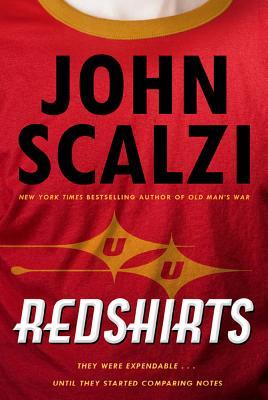
Books you should have read already: Redshirts

Sorry about the delay but, well you know, the hurricane and power outage and all that jazz. But I'm back and I have a fun pick this time.


This is flat out a satire and meta analysis of Star Trek. It takes the tropes and plays them out. But what this novel does is put realistic, logical, aware characters in the field of cliche and formula. And it's hilarious. You can take it as a love note to the franchise or you can take it as a playfully gruff punch on the shoulder to science fiction in general. There's a lot for Star Trek fans but there's more than enough for scifi fans as well.

And that's just the first part. Normally codas are little extras but with this book the three codas are equally as important as the story. They each continue the plot by way of different characters and it's really in these codas where the point of the book comes through. The amount of heartfelt love for the story, characters, and world is great. The story has touching moments but there's a lot of world building and deconstruction. The codas are these nuggets of pure character and each with its own perspective.

It's hard to review a book that's as meta as this. I don't want to come across as selling it as a Star Trek story because it absolutely is not. I don't want to sell it on the amazing irony and deconstruction because it stands on its own as a real science fiction story. It is what it is, and that's a funny, smart, highly entertaining book.

Sunday, October 28, 2012

Books you should have read already: The Flame Alphabet


And now begins the stand alone novels.


The Flame Alphabet is a very hard book to recommend. I want to recommend it to you all, and since I'm writing this I suppose that I am. But, unlike Feed or The Magicians, I don't for a moment believe that this will have the same universal appeal.

The Flame Alphabet's plot is this: There is a plague striking the world, or at least America. The speech of children is striking those that hear it ill as well as leaving a salty residue that spreads in the wind and strikes bare the soil. As time goes on this plague gets worse until the very foundations of communication may become poisonous to all humans.

That doesn't sound too depressing. It's a new take on the apocalypse  In fact, it's a Jewish apocalypse story and it's reflected throughout. There are issues of community through ideas, independent reflection and the meaning of community. It's explicitly Jewish, though some aspects are very twisted to the point of grotesquery and horror.
But it's also a story of a world where isolation not only tears people apart but also makes them confront how alone they are to begin with. That's the scariest part of this book, which isn't explicitly horror though I did find it genuinely scary. The seeds of the main character's sadness and existential dread get traced back to his family before they are split apart by this disease. Think about it, if the speech of children is toxic then how long do you think parents would be able to stand the proximity of their children? How long could children stand to stay and slowly kill their parents? But also, upon reflection, once you can no longer talk to your family- what if you find that your relationship doesn't change as much as you feared?

That's all in this novel. Ben Marcus, the author, does perhaps too good a job at reflecting these themes in the tone of the book. By the end of the novel I was reading chapter after chapter in a single sitting, gnashing my teeth. But early on I had the hardest time getting into the prose. It's dry and depressing and more than slightly sickening. The text felt like the salty air in their world, slowly pulling the moisture from the air and hurting you from the inside. I kept wanting give up on it, rereading the synopsis, and realizing the concept still intrigued me. It took about halfway through before the book and my mind synced up and just clicked together.

So I do recommend this book. Highly. As soon as I completed it I was happy both to be through with it and to have the ideas it planted sitting in my head. In a way it's almost the antithesis of the movie "Butch Cassidy and the Sundance Kid". In that movie the writer set out to create a script that showed two close friends that would ultimately become aware that they don't and can't truly know one another. By the time the writer finished the script he had a story that showed two people who did know each other and he had to reverse his thesis. In The Flame Alphabet we see that not only do some people get pulled apart by the enforced lack of communication but perhaps they were never even close to knowing each other even when they did talk.


I promise the next one will be a lot lighter in tone.

Saturday, October 27, 2012

Books you should have read already: Feed

And now we come to the top series in this run of recommendations.


This series has been a hard sell to most people I recommend it to (which is everyone). It presents itself so strongly as a certain book and it's not. This book takes place after a zombie apocalypse but it's not about zombies. The main characters are reporters and a large portion of world building is devoted to how news media was restructured after the rising of the dead but it's not a media study. The position that sets the group off on their adventure is to follow a politician who is running to be the Republican presidential candidate but it's not a political thriller.

This is technically a hard sci-fi medical thriller. But it's not really that either.

What it really is, is amazing. There are two types of people I know.
  1. People I have recommended it to and have absolutely loved it.
  2. People I have recommended it to and they have not read it.
With complete sincerity I tell you that this book has a 100% "love it" rate by those who I pushed it on and have read it.

Our narrator is Georgia Mason, a sharp edged, hard as nails news blogger who sounds like equal parts Rick Grimes and Hunter S. Thompson. It's 25 years after the zombie uprising. People have survived and learned how to keep living. Everyone is infected. Everyone is scared. And life goes on. The news media was hesitant to admit zombies were real. Sounds too silly. But bloggers jumped on that story and kept people posted. And so bloggers have survived into the new world. Her group lands a prime job, following around Peter Ryman who's fighting for the Republican nominee spot. And then things get intense.

I'm specifically light on plot details because this book absolutely speaks for itself. The Magicians made me fall in love with reading again and this series places a spot above that book.

And when you're done with the trilogy and the two novellas (the prequel takes place at San Diego Comic Con in 2014) then head over to my friend Mark's blog, Mark Reads, and reread it along with his chapter-by-chapter reaction/reviews.

Friday, October 26, 2012

Books you should have read already: The Magicians


The final two series reviews get a bit heavier. This penultimate series is the last fantasy series I'll try to sell you on. It sounds like Harry Potter but actually is incredibly far from it. I'm pretty sure some of the more dissatisfied responses to this book are from people expecting to find the next Hogwarts and instead getting highly flawed, modern literary characters.

The concept is that Quentin Coldwater is a student ready to leave the world of high school and enter college. He has a friend who's dating his crush and they are essentially a trio. But they vanish early on in the story when Quentin gets tested and accepted to Brakebills, a magical college.

In fact, that set of establishing a trope and then tearing it away to see how the characters react is the running theme of the first novel. Quentin is part of a tight knit trio, then they are gone and he must cope. Quentin is expecting his college days to me like Hogwarts but instead it's actually an incredibly dense and difficult curriculum and he's no longer acing tests effortlessly. And each time this reveal and revoke is called upon it makes the characters involved much deeper. Or at least makes them confront their flaws. Like real people, some of the students at Brakebills aren't necessarily looking to constantly be introspective and better themselves. Some want to get laid. Some want to just get by. Some want to put on airs and affectations in order to hide their insecurities.

I won't give away too much of the plot but I will say this. Do not go in expecting Harry Potter. Instead, realize that Quentin loves magic because of a series of books about a magical place called Fillory. It's a very thinly veiled substitute for the Narnia books, right down to the heavy handed Christian allegories. And it is this series that plants the seeds of what magic and wonder should be for Quentin and therefore influence The Magicians. These books have adventure but it is almost despite the characters, not because of them. While adventures seem like a great idea on paper most people wouldn't want to throw themselves out of their comfort zones and place their lives in jeopardy just as they're discovering magic and, by way of it, a life of unimaginable luxury and metaphysical academia. The conflict in these books, like most things, is a reveal and revoke. You see an adventure coming and then it's here. But it's the internal clash that everyone has to face because these adventures where the real story resides.

Another way to put this book in context. When I reread it this book was perhaps one of 4 novels I had reread in my adult life. This first book in this series is what set me evangelizing books again.

Thursday, October 25, 2012

Books you should have read already: Skulduggery Pleasant


Young adult "chosen one" fantasy series are a dime a dozen. Before dystopian (Divergent, Hunger Games, Uglies, Delirium, Maze Runner, Cinder, Incarceron, City of Ember, etc) was in vogue you couldn't swing a dead house elf without hitting one. And as much as I enjoy the world of Harry Potter I will flat out admit that
[off topic criticism redacted]
So what does Skulduggery Pleasant have that sets it apart? So, so much. There' darkness, a snarky narrative that doesn't talk down, fantastic humor, more snark, interesting characters infused with magic, dynamic characters that have long term character arcs and sometimes relapse with lasting consequences. And snark.

In short, I was very nearly mad when I finished this book. I was so close to furious that I hadn't written it that the only reason I didn't tear it in half was that it was too damned good. I have laughed out loud while reading this series. I have gotten attached to these characters. Oh, fine, let me tell you a little about them.

Stephanie Edgley is the protagonist we follow. She's 12 at the time and her uncle Gordon has just died. Gordon was a horror writer but upon inheriting his estate, Stephanie finds out that much of what he wrote was based on the people he knew well. Soon Stephanie finds herself involved in the policing of this magical underworld of Ireland by way of Gordon's friend Skulduggery Pleasant. He's a smart ass, has a questionable past and is a well dressed skeleton.

The minor characters just flesh out the world with depth. Rather than trying to saddle Stephanie with some sort of male foil/romantic interest we are given Tanith Low, who becomes a running sister figure. In the later books Stephanie does meet some interesting male characters but her independence is never compromised and becomes a strong sticking point to her relationships. There's also a wonderful bit that brutally addresses some of the themes that are romanticized in Twilight.

Later on we have side characters that change allegiances with lasting consequences, studies on the effects of self sacrifice and whether self destructive behavior is warranted and when. This shit gets dark, all the while getting deeper and deeper into the world.

And unlike Harry Potter it does get around to dealing with the issues of superiority in the world between magical and mortal. It seems strange that in Rowling's world the magic community has this bizarre reverence for the non-magical people and practices. It seems pretty obvious that in that world magic is plainly superior. Well, that's not something Landy ignores. When crossing over to this magical new world what reasons would you need to go back? How important would your family life be when actually offered the chance to run off, live for centuries, and physically control the elements as well as life and death?

But don't get the wrong idea. These books are YA fantasy. They are adventure stories and they are, without hesitation, fun. I also recently gave away my dead tree edition of the first novel which just goes to show you how invested I am in sharing the wealth of this serie

Wednesday, October 24, 2012

Books you should have read already: Libriomancer

I consume what could be described as "copious amounts of media". I go through movies, TV series, and books. Part of this is due to my mastery over the mystical powers of insomnia. Some of it is just due to me loving the feeling of finding amazing stories. I also love seeing someone else discover something that they love, hence my constant recommendations to people. Movies and TV are easy. They tend to be social in that people get together to watch things. Books are a more solitary sport. People don't really have parties where they gather in groups and all sit down to read.

What I'm doing here is codifying recommendations of things I've read in the past year or so and I'll be grouping them in the following way:

  • series
  • stand alone
  • collections
  • ambiance
I will start with "series" and I will work my way from weakest to strongest recommendation. Of course, take that in context. That's the weakest "you should have already read this".

Oh, and if any of you are down with the e-readers, let me know. I might be able to help you out.


I suppose this one counts for part of a series though there's only one book out at the moment. More than anything this book is cute. It's a smart take on magic and literature. The concept is that there's a class of modern sorcerers that can use collective belief and have focused that through books. The more people read and put emotion into stories the easier it is for them to pull out artifacts from the books. They are libriomancers. The actual story isn't astounding. The world itself isn't even as compelling as some other fantasy I've read. But there are parts to this book that shine.

The concept itself is a meta-aware love letter to readers themselves. The idea that the more invested people are in a book the more real it becomes (now literally) should speak to all readers. The author even plays around with that, touching on intent of the writer affecting the prose as well as self publishing.

But there's also another layer to this toying with tropes and creation. I won't regurgitate the character description but the side kick is an interesting take on the hot, sexy, magical urban fantasy female. For that alone I know some of my friends will love this.

And something else that impressed me was that Hines actually has characters that try to find and push the boundaries of their magical system. While one would think that this would be something nearly every strong, magic wielding character would try it's actually quite rare in fantasy. For the most part inhabitants of magical worlds are satisfied to learn the basics and use magic exactly as the instruction manual says to. But Hines realizes that his magicians are creative types. It seems that the standard cover for libriomancers are book store and library workers. How many of those people do you know that don't write? So of course you should have experimentation going on when your self selected magical population is mentally set to play games with power and concepts.

Of course, there's the added bonus that many of the items pulled out of books and used as tools are from real novels. So playing "spot the reference" is a bonus game woven into the text.

I don't want to talk this book up too much. I know this blog series is called "books you should have read already" and with a title like that there's a certain level of expectation established. This book, I feel, is not quite the sum of its parts. I finished the book feeling fair about it. I wasn't blown away and the story was good enough. But it stuck with me and it wasn't until I really thought about what I liked in it that I appreciated  Libriomancer more and more. Feel free to insert your own comment about this criticism being a parallel to the way in which libriomancers reach into books and extract the parts that resonate and give power. I just realized that too.


For more on pushing and exploring magical systems see "Harry Potter and the Methods of Rationality". It's ongoing, long and probably drier than many of you will want to deal with (natural born salesman right here!) but it's incredibly interesting. It also shows how utterly thin some popular fantasy realms really can be.

Monday, March 26, 2012

Hunger Games review

I left Hunger Games really liking it. There were some things that were slimmed down but I felt that not a lot of importance had been omitted. The main thing I felt was missing was a lack of scale to the nation. Instead of a whole country converted to districts it felt more like a city state with outlying villages, but I wrote that off because that scale doesn’t really enter the books in a meaningful way until the second installment.

But the next day I thought about it and felt that there really is a number of things missing from the movie.

Jennifer Lawrence is really good. I didn’t see Winters Bone but found her impressive in X-Men: First Class. Josh Hutcherson as Peeta was good enough, though he doesn’t hold the same “gentle giant” sense that the character has in the book. Here he’s a bit too small and his face too boyish. Perhaps that will make his character all the more shocking in the 3rd movie but for now the casting choice seems too thin. The rest of the tributes work well enough though none of them are really given much material to work with. Rue essentially has two or three scenes, once of which is simply her hiding in the ceiling. It’s nice that Isabelle Fuhrman from Orphan got a few lines but the rest of Kato’s gang just seem like cruel muscle without any individual characters in there.

But as I said, there is a lot that’s smoothed over to the detriment of this movie. Woody Harrelson’s Hamish is serviceable but there’s no regret or even conflict over his role of mentoring two children in a Thunder Dome situation. He also makes alcoholism recovery look like a breeze.

Another character that is neutered, this one to an even greater extent, is Cinna. He doesn’t come across as calculating or subversive. He is more like a contestant on Project Runway that doesn’t listen to criticism from the judges than a counter-cultural radical as he is in the book. In the movie he’s a sympathetic shoulder and that’s why Katniss takes to him. In the books he makes it his mission to fight the establishment which is why Katniss finds strength in him as an ally.

Finally, there’s portrayal of Katniss’ romantic life. This is probably the most problematic part of the movie for me. The book is in first person which comes with its own set of limitations. For instance, in the books we only find out about District 11’s riot in the second book, long after it happens , because this is when Katniss finds out about it. Seeing it in chronological context in the movie made the seeds of revolution feel like they were planted instead of just being informed of something important later on. The upside of the first person narrative is that there’s no actual romance in the first book. The entire emotional engine of Katniss and Peeta is that she is being completely calculating about the whole thing. She feels nothing for him (yet) and so there’s a tension in their “romance”. Every action she takes to look kind and loving is a lie. The more Peeta keeps true to himself in the arena the more of a show she puts on for survival’s sake. In the film we see none of this and it’s quite possible that their interactions are nothing more than a teenage romance which weakens the very core of Katniss’ character. Gale barely figures into the story at all. In the books he’s a hunting mentor to Katniss; in the movie he simply tags along while she hunts and pines for her while she’s gone. With that dynamic chopped it’s is another layer of Katniss that is thinned out as well.

What bothers me is that in cultural context The Hunger Games is seen as a counter-Twilight series. Instead of the epically passive Bella you get the compartmentalized, driven Katniss. There’s a romance but it is started as an act and takes second place to the heroin’s role in the larger story of revolution. The movie can’t take that role though. While not nearly as socially repugnant as Twilight, there are too many similarities in the movies for it to find similar footing to the books. While not abusive in the same way as Twilight we are still given a couple made up of a pro-active and driven character and a passive, lovesick one (a formula I call the coward's romance since the only obstacles are self-imposed), with a third party looking in without enough emotional importance to truly make a tension filled triangle.

I think a fair way to describe the film is still enjoyable but on reflection perhaps less satisfying. I don’t know whether reading the books has helped or not. Reading them may have made me seen more faults in the movie, or it may have let me imprint emotional depth into it that wasn’t conveyed in the film version alone. I do not know if having read the series was a hindrance or a boon. But I have read them so I know that the world building increases in the subsequent installments and that the emotional connections established here are replaced with different ones so I do have that to look forward to. But part of me wonders if the story would be better served with a director with more vision.

On a scale of -5 to 5 I rate Hunger Games a 3.

Saturday, January 21, 2012

Review of 11/22/63 by Stephen King


11/22/63

by Stephen King

*possible spoilers*

I've recently read a string of mediocre novels and put out a call for something to really enjoy. I was recommended 11/22/63 bu Stephen King. I approached it with apprehension. There are a number of things about this book that would have stopped me from picking it up on my own. It's historical fiction, which I generally find dull. It's first person which I see as an over used style to let the author feign the depth of a main character by making everything seem more immediate and intense. And it's by Stephen King.

I don't think I've read king since I was maybe 14 at the latest and when I did it was to put me to sleep. I have always found him heavy handed, long winded, nostalgic to the point of laughable, and formulaic. I was willing to give him a second chance and was told that this was the novel to win me over.

It wasn't.

The basic story is that a man steps through a literal door in time that takes him back to the late 50s and he plans on using this to stop the Kennedy assassination. See the title? Good. And from that I was actually interested. I put aside my reservations and plowed through this thing. And I was surprised that the Kennedy story was actually pretty darned good. But there's a problem.

The problem is that Stephen King gets in the way of the story. Literally. The entire first act of this tome is a complete waste where King sets the main character up to be himself. He goes to a small town that has a general sense of foreboding, finds that something possible magical and definitely evil is driving people to victimize children. He encounters friends that have some sort of magical power. There are comments about a clown that lives in the sewers and kills the kids. It is literally all stuff that we've seen before.

This town becomes the cover story the time traveler uses. He presents himself as a writer who is penning IT. Then the book focuses on a romance starting with the next act. I suppose it's necessary as he has no actual motivation for going into the past other than a diner cook tells him that stopping the assassination would make the future a much nicer place. With the romance he now has a reason to spend years hiding out until the trip to Dallas. But this romance gets in the way of both his mission and the furthering of the story. He splits his time between his girlfriend and his mission and therefore the narrative gets watered down as well. He's not a compelling person (he's King's avatar) and spends more than half his time trying to make a life for himself in the past.

I got bored waiting for the author and the main character to get back to their mission. Eventually they do but, thanks to King's need to make his settings vaguely sinister, time itself sends car accidents and unfortunate minutiae to thwart his attempts to change things. Maybe it's because I've read science fiction before but I found this turn a trite one to add drama and conflict where there was none. I won't say what the outcome of his rescue attempt is but I will say this: after the climax there's a halfhearted attempt to show a bigger picture that fails terribly. It comes far to late and doesn't hold up without further explanation. Which never comes. Instead there's a wistful, and essentially pointless, denouement. Perhaps it would have been a more satisfying  ending if I had picked up what I thought was to be a romance centered novel but I didn't. I was sold and signed up for a time travel/historical story. It's like going to see Back to the Future Part 2 and instead seeing a showing of Somewhere in Time.

On a scale of -5 to +5 stars 11/22/63 gets -2.
I would have given it a -1 but I was interested in the Kennedy plot so I was really bothered when King failed to deliver on it.

Monday, December 19, 2011

Hugo: a review

I just saw Hugo last night. All in all I enjoyed it. Martin Scorsese made a very pretty movie and it was really well acted. It has been receiving universally good reviews (93% on Rotten Tomatoes as of this moment) and I can understand why. For what is framed as a children's movie it comes across as a lovely period piece. Asa Butterfield was fantastic. Chloë Grace Moretz was also very good though I often felt she was sticking to the Wendy (of Peter Pan) school of acting: be wide-eyed and say "Adventure!" a lot with a British accent.

Yeah, a small thing I found very odd was that everyone has a British accent and this movie is supposed to drip with Paris. It often does but I do not understand why everyone either kept or put on a British accent to be French.

The real thesis of the movie isn't really about Hugo and his quest for familial fulfillment. It's about film preservation. I say that because the last act takes a narrative turn. It's been a while since I've read the novel but I think it balance both Hugo's and Georges Méliès' (Ben Kingsley) stories a bit better. The film seems to be about Hugo, then both and ends explicitly focusing on Georges and his life and career. The entire last act features the titular Hugo as a supporting character. While it didn't kill the movie for me it did feel like they partially abandoned Hugo's importance in the narrative, though thankfully still finishes his story. I know it's a delicate balance in the book, served by featuring the dénouement as a separate epilogue that places Georges story as a part of Hugo's life rather than tucking Hugo into Georges story and family. It's a subtle thing but makes all the difference.

The weaving of film history into the main plot is done, barring the end, well. Though slightly too on the nose in a few spots I found it a strong thread. There are side stories told in near pantomime, making the silent films experience by the characters also experienced, and relevant, to the audience. There's a romance between a couple of Harry Potter alumni and a romance for Sacha Baron Cohen's station inspector that takes him from a caricature to an absurd but full character.

Touching back on the film thesis there were two things that felt slightly off about it. The first is that it's in 3D. For something glorifying the days of simple stories and the most mechanical of practical effects this movie really delights in CG and 3D. I was thinking about that and realized that the only movie I have ever seen in 3D where the screen disappeared and I simply experienced the story in my head was Coraline. With good 3D the depth is usually rendered behind the screen. When things project it may be fine for a 3D gag but the audience doesn't actually believe that things are appearing in the theater with them. With depth it helps build the illusion of a window but still I always find myself aware that I'm not watching a play. With Coraline not only did they go for the recessed effect but they are stop-motion puppets. For that my brain allowed me to believe that perhaps I was watching puppets, I bought the illusion and at times the story took over. I've never experienced that with live action 3D the way that the best 2D films sometimes take me away from the theater or living room and put in inside of the story.

I found it a little strange and a little depressing that Scorsese felt this helped convey the magic of simpler films. Likely he became enamored with the concept of having an audience watch the silent footage of that early film of the train and feel at least a touch of belief that it would hurtle out at them. Perhaps it's because of a saturated 3D market or perhaps it's just an effect that is dated and impossible, but this movie did not deliver that. That's not to say that the 3D is bad. It adds a nice depth and there are times where it creates a very good sense of space. But I don't think that this movie would suffer if shown in 2D and the 3D never feels needed.

The other thing that popped into my mind was that it's odd that Scorsese chose this project to make a love letter to film restoration. Yes, that's really in the original book. It's just a little bizarre Scorsese's call comes in the form of a movie based on a novel. Really? From a writer's point of view that is discouraging. Something so personal as a love letter to the medium of film from a master director can't manage to be something on its own? The best way to pour this message onto the screen is from a book? I'm glad it was made and it's a fine adaptation; hopefully it will get Selznick's books out into more hands. But the fact that this billet doux to film was born from a novel takes at least a small amount of authenticity from it.

On a scale of -5 to +5
Hugo is a +4.

Saturday, December 3, 2011

TV that I watch


It seems a bit weird to start writing again and make it all about television but since I haven't been writing I have been watching a lot of tv and reading a lot of books. That means I'm going to have reviews to toss out. And rather than giving these my usual +5 to -5 rating I’ll be judging them by current watchability:
LOVING IT
SOLID
GOOD ENOUGH
HANGING ON
NEARLY DONE WITH IT
QUIT

PS These are shows that are currently airing. I held back on things that are between seasons or between partial season or whatever the hell the networks do with their shows.


  • Monday
    • How I Met Your Mother – NEARLY DONE WITH IT
    • House - SOLID
      • Most of the people I know who used to watch this have given up. I am honestly enjoying what they’ve done with the character of House recently. I thought that the stint in prison was really good and I like that one of the members of his new team is pushing him right back. I’m a little confused as to why Chase is still around. He’s had the longest residency I’ve seen and after his divorce they really haven’t done anything with him. He’s just – there.
    • Adventure Time with Finn and Jake – LOVING IT
      • Adventure time! A post-apocalyptic cartoon about the last human and his adopted brother, a shape shifting dog.
        This show is amazing. The music is great, the animation is adorable and the humor funny and bizarre. I’m pretty sure this is one of those shows where you immediately love it or hate it. So far I only know of people who love it or have not seen it. Check out an episode.
    • Terra Nova – GOOD ENOUGH
      • It’s OK. To be frank, it’s Avatar painted with Jurassic Park. It’s derivative, the special effects range from passable to cringe inducing, and some of the characters feel like they are trying to fight against developing so they can continue playing generic tropes (all the kids come to mind). Why am I watching this? It’s fairly entertaining and it’s science fiction.
  • Tuesday
  • Wednesday
    • Todd and the Book of Pure Evil – LOVING IT
      • A metal loving high school kid uses the Book of Pure Evil to become more metal and get the girl he lusts after. He nearly kills everyone at his school. His plucky one-armed friend and the girl stop him but the book flies away. It does that. They band together to find the book. Oh, and did I mention that the girl’s father mysteriously vanished while investigating this book? Because he did and it’s totally mysterious. But I’m pretty sure the evil guidance councilor had something to do with that. Because he’s evil.I am so in love with this show, though I’m still just in season 1. It’s like Buffy and Evil Dead 2 and Middle Man had a beautiful, bloody, foul mouthed three way baby. The only thing I’m not crazy about is that it’s a half hour show so each plot is wrapped after 22 minutes instead of 40-something. I suppose that’s a trade off. While some episodes seem too short it also means I’ve made it through an entire season and not a single episode has dragged.
    • American Horror Story – SOLID
      • Re-titled Ghost Fucking
        This show is so cheese it’s wonderful. My wife flat out likes the show a lot. I don’t know if I can make that claim but I do find it highly entertaining. The “name that horror reference”, which was so distracting early on, has dropped to a much more tolerable level. A lot of camera angles and soundtrack cues are lifted directly from horror films so at the very least it’s an impressive meta-analysis of the horror genre.

        More recently in this season it has come into its own as a standalone horror story. It took a while for the mythology of the house to get rolling, and while there are still a few hiccups in their world building (what exactly is the rule about ghosts leaving the property?) overall it is really rolling.
  • Thursday
    • Big Bang Theory – QUIT
      • Much like Leverage this is another show I didn’t choose to stop watching. The references are nerd-catnip and some of the performances are really good (though Howard is beyond done). But when it comes down to it this show is basic sitcom. The references usually don’t actually show much more understanding of a geek subject than Wikipedia and the show never tries to rise above the standard sitcom format. I guess I just felt like it wasn’t offering anything more than what I get from my real friends.
    • Bones – HANGING ON
      • It seems that wherever I tune in another show has decided to infect the cast with a little bundle of ratings. I could be wrong but wasn’t the addition of a baby to a show usually a kiss of death? Perhaps that was just for children characters and baby’s don’t actually count. Whatever the old rule was it is clear that babies are now in vogue. I was actually interested to see what would happen with Angela and Hodgins' baby. It’s Bones’ pregnancy that I’m annoyed with. Her gimmick was being so logical as to alienate people. Now it seems that they’re just playing that against the “hormones hormones hormones” of pregnancy to make Bones comedic and possibly insane. The writers couldn’t find another way to get Bones and Booth together? I’m still watching the show but I will admit that the episodes tend to sit unwatched for longer periods of time.
    • Person of Interest – HANGING ON
      • I officially dropped this show but then went back to it. Not because I read that it was doing something good and I wanted to see. Only because it’s produced by JJ Abrams and every time I give up on it out of boredom I get the sneaking suspicion that, since it’s an Abrams show, it has some sort of big picture that it will get to. I have now admitted to myself that I will follow the first season but if no long term plot peeks its head out by then I’m probably going to call it quits.
    • Mentalist – between SOLID and HANGING ON. Hanging on and a half?
      • This show is definitely in the “OK, not great” zone. Last season: “Yay they took care of Red John. Boo, they didn’t solve anything with Red John.” The show has become a string of competently written one-off crime stories. The bad thing is that the series is now just treading water from week to week. The good thing is at least it’s with characters I still like.
    • It's Always Sunny in Philadelphia – LOVING IT
      • If this show were simply a weekly monologue of Danny Devito shouting the word “who-er” for half an hour I would recommend it. What’s even better is that this show is so much more than that. While things this season haven’t touched on the greatness of The Nightman Cometh it has still been some of the best comedy on television.
  • Friday
    • QI – LOVING IT
      • Quite Interesting – a very funny trivia panel discussion hosted by our lord and savior, Stephen Fry.
        Delightful as always. I now am usually a week behind because I’ve since switched over to the QI XL format.
    • Supernatural – SOLID
      • This season hasn’t been great. They wrote off Cas and I miss him in the show far more than I expected. Plot wise it felt like these villains had no aim and when it did come out I immediately recognized it as the exact same idea that the Alliance used in the movie Serenity. Exactly the same. And some of the writing has come across as a little lazy.

        Despite all of that this show is still good enough to get me watching each week. The brothers Winchester are still good enough characters to hold the show together on their relationship alone, which is what they’ve been doing. Hopefully the writers will start to bring Dean to a boil, as he’s been simmering all season and something needs to happen to trigger him.
    • Grimm – HANGING ON
      • This one is just hanging on. I’m not sure if it’s sticking around on its own merits or strictly because it is better than Once Upon A Time. That said, the main character and his sidekick are boring. The sidekick is slightly comically slightly awkward. The main character, who’s name I can’t even recall, is beyond bland. He came prepackaged with an interesting lineage of creature hunters called Grimms but it seems that was enough for the writers. The touch on him trying to do research every so often but really he’s just there because there is a conspiracy that involves his somewhat more interesting family. The only reason to watch is the big bad wolf character. The show really should have been about him, perhaps with a Grimm sidekick trying to find his place in the world. Now that I think about it, that would have been a much better narrative frame.

        And speaking of framing, it seems odd that every police case this guy has investigated since he learned monsters exist has revolved around monsters. So how the hell did he solve a single crime before? Did he just spend his career until now putting innocent humans away? That’d be an interesting show.
  • Saturday
    • Would You Rather –
      • This show hasn’t actually premiered yet but I’m really looking forward to it. It’s the classic game where you are presented with two unwanted options and need to choose one. What looks really fun is that it’s hosted by Graham Norton and the guests look really good. Examples? In the first two episodes they have Cyndi Lauper and Stanley Tucci.
  • Sunday
    • Misfits – LOVING IT
      • A crazy ice storm hits London and lots of people find they now have super powers. This show follows a group of juvenile offenders so they aren’t exactly heroes.

        So we’re now into the third season and this show is still brilliant. They’ve taken some risks, like switching out everyone’s powers, and they’ve hit some hurdles, such as fan favourite Nathan leaving the show. It’s still good. Really good. The Hitler episode was miles above when Doctor Who pathetically tackled that gimmick and some of the things they are doing with gender is really interesting. They handle pretty intense issues with thought rather than disgust and fear. And while it’s often funny and definitely British this show is not
        No Heroics. And it’s certainly not Heroes. Maybe if you took the quality of Heroes’ first season, removed a lot of the borrowed storylines from Marvel and DC and made the characters less mopey. So not really Heroes at all I suppose.
    • Penn and Teller’s Fool Us – LOVING IT
      • A number of magicians go on stage in front of Penn and Teller. They perform a single trick. If Penn and Teller cannot figure out how it’s done they win a slot opening for Penn and Teller in their Las Vegas show.EDIT Just noticed that this show is between seasons so don't look for new ones just yet.
        This show might not have the gravitas of Bullshit! or even Tell a Lie but this show brings me joy. Flat out joy.

        They are going on stage to trick two amazing magicians so you know that they are going to be bringing their best. Not only that but a lot of these tricks are different enough that they contain an illusion or method Penn and Teller might not know. In addition to some jaw dropping skill you also get the wonderment of P&T when they don’t solve it. When they figure it out there’s a comfortable and friendly nod of understanding but what I love is a trick so good that not only do I not have the slightest clue but neither do the experts. They are impressed. They are mystified. Sometimes it may be a trick I think I know and it turns out that it’s not done in the standard way. And it’s amazing.

        Magic tricks can fulfill on two levels: 1) a show of skill and 2) mystery. Penn and Teller’s Fool Us usually delivers on one of these and sometimes both. It’s in those moments, when I can rewind, watch in slow motion and the only thing I can discern is that I don’t know what’s right in front of me, that this show brings actual wonderment. And I love it for that.
    • Walking Dead – SOLID to LOVING IT
      • The end of this season was the kick in the pants it needed. Recently things have slowed down and it hasn’t been great for the show. They’ve been staying at the same farm for most of the season, they’ve been looking for an unimportant stock character for even longer than that, and the show has been light on zombie kills. Well, until the massacre for the mid season finale. Finally, the little girl search is over, Hershel’s farm has come to fruition, Shane has completely lost it. It’s fun again.

        I admit, earlier on this season I was skeptical. I could feel the shift in writing, the lack of Frank Darabont, and the lower budget. The mid-season finale was a killer and I hope it means they’ve found their footing. At the very least they won’t be looking for Sophia anymore.
    • Once Upon A Time – QUIT
      • I just officially gave up on this one. I don’t buy Jennifer Morrison as a bounty hunter; she was tougher when she was a doctor on House. The kid that this whole concept hinges on is crap. He has no personality of his own and isn’t a terribly good actor. The whole thing reeks of one of those ABC miniseries that has been dragged out far past its welcome.
    • Leverage – between HANGING ON and QUIT. Quit and a half
      • I didn’t make a choice to stop watching this, I simply stopped caring enough to catch missed episodes sometime last season. Every now and then there will be a stand out fantastic episode, and the guest stars are usually a treat, but the show itself just didn’t hold up enough to keep me engaged. This is towards the top of my “Frak, there’s nothing on. What should I catch up on now that all TV is on mid-season hiatus?” list so I may come back to it. It never got bad while I was watching, just stopped being good enough.

Saturday, July 24, 2010

Christopher Nolan has an existential thesis, not a crisis

I just finished a Christopher Nolan movie in which a man accidentally becomes responsible for his wife's suicide. To deal with the grief and guilt he builds a world made of real, false and modified memories. He then progressively falls deeper into this absolution fantasy until he can no longer tell reality from his personal fiction. This movie is called Memento.

There's been some writing on how Inception is similar to The Prestige in that the main characters act out various functions in a trick or con that closely parallel the creation of a film. While this is true, Inception is not really a spiritual twin to The Prestige. Rather, it is a philosophical continuation to Memento. Both Inception and Memento are existential exercises in what makes a person's perceptions real, how real are they and does fact matter as much as how we comprehend it. In both of these films the main character creates their own reality which is built upon a foundation of meaning rather than fact. What's interesting is that in both cases this is revealed to us. Granted, in Inception it is done in a much more circumspect way but both movies clearly state at the end (and in the case of Memento the beginning as well) choosing to live within a falsehood may distance one from reality but it will ground one in their own drive to survive. The character of Teddy in Memento says that everyone lies to themselves to be happy. Nolan's repeated thesis is one step further; that some people lie to themselves to survive, even if it takes one away from happiness.

What's really interesting is after paring Nolan's existential perspective down to this concept we see it manifested more in Dark Knight than we do in The Prestige. At the end of Dark Knight the audience sees that Batman is faced with a dilemma. After Harvey Dent turns to murder and then dies, Batman has to choose how to present this to the people of Gotham City. He can give them the truth, that their near saint of a DA has turned to murder and tried to kill children, or present them with a lie, that Batman is a killer and Harvey Dent died in the pursuit of justice. The truth would devastate the community while the lie would strengthen their convictions about good people in power and therefore add stability to a shaky metropolis. As Leonard does in Memento and Cobb in Inception, Batman chooses to preserve the lie that gives purpose over the truth that would destroy.

Taking this concept back to The Prestige we see a bit of this peeking out, but only in shards. Hugh Jackman's character is never able to figure out what is the truth (whether it was a difficult knot that led to his wife's death or simply her inability to perform the trick) and without truth he can never face the existential crisis of purpose or truth. It seems that it is this situation that makes Jackman's character turn outwardly destructive. In the other three films the characters choose lies and turn it into purpose but also self destruction. Their choices to build their world on falsehood adds fuel to their fire, making them burn stronger rather than sputtering out but also burn faster. The obsession that comes out of not being able to choose in The Prestige leads to an outward feud, to a life of external destruction. Both of these situations lead to erosive lives but only when faced with a choice to deal with the truth and make a voluntary choice to live within a lie does the character find any fulfillment in their existence.

The situation I'd like to see Nolan tackle next is making a character face the choice between truth or purpose and choose truth. Purpose over truth shows a materialist pragmatism but what would people inside of a world created by Nolan do if they took the philosophically ideal path?

Monday, July 19, 2010

A quick note on what INCEPTION is (SPOILER FREE)

INCEPTION is not the best movie ever. Ebert's blog below is all about that. However, it is very good. It is Nolan's best; far more satisfying than The Prestige and far more refined and masterful than Memento.

INCEPTION is very good. It's not perfect but a lot of fun and you get to think.

INCEPTION is not incredibly smart. It is competently smart. It is not quite clever. It is complex. Christopher Nolan was smart and clever as a director. The construction of the film is brilliant. The actual movie is less so, though by no means dumb. You need to pay attention and think during the movie. You should leave being reasonably sure of what happened. Most of its secrets will clarify after some reflection.

INCEPTION will not change movie making or story telling. It probably won't change your life but it is still a very good film.

Recently there has been some confusion between complex and clever. And much like irony it is something that is much easier understood when witnessed than explained. The first season of LOST was clever. The later seasons were complex. Christopher Nolan shows himself to be a clever director while making this complex movie.

INCEPTION link - THESE DO CONTAIN SPOILERS
11 Points about Inception
Ebert's blog on Inception reviews
CHUD's "solution" to Inception
Salon.com All About Inception

Wednesday, June 30, 2010

Toy Story 3 - Both Dynamic and Flat

The other day I was thinking about Toy Story 3 and the Toy Story series in general.  I'm not a huge fan of them, though I did enjoy the 3rd one.  I tried to figure out what about the movies didn't really work for me and it occurred to me that while (some of) the characters are three dimensional their world view is too flat for me.

What do I mean by that?  Well, we see how the toys grow and learn from each other.  Buzz goes from a tool to one of the gang. Yay.  What we don't see is any of the toys actually thinking beyond the set of roles they are presented with.  They are told that they are supposed to function as entertainment for children and they follow this role with dogmatic adherence.  Even in the 3rd film, in the midst their fears of being rejected possibly coming to fruition they stick to that same role in all their choices: stick with Andy or move on to other children.  At no time to they think that after being thrown out the then have complete control over their lives and movement.  They are free not only to entertain other children but they can also venture out on their own.  While they do derive pleasure from making kids happy we know that they can find emotional fulfillment in other ways.  Just look at the happily married Potato Heads.

The only character to question this role is Lotso, the sinister and unredeemed bastard bear who rejects children.  But putting this up as the alternative lifestyle against the forever devoted Woody is a bit of a thin and pathetic dichotomy.  If children are seen as gods then this is the equivalent of portraying all people as devout fundamentalists or self-assigned anti-Christs.  Woody has pure and ultimate faith in Andy and any child who he serves.  Bringing them joy, no matter how neglected he becomes, is his only purpose in life.  Lotso, alternatively, actively distrusts and hates the capricious children and essentially makes his goal in life to live a completely hedonistic lifestyle while punishing believers.

I understand that this is ostensibly a children's series but it's Pixar.  We're allowed to expect more from them.  That combined with the fact that this is the third installment means that there's a reasonable expectation that these characters could grow to question the world they've inhabited since 1995.

To be fair, Pixar still brings the Toy Story characters to a level above that of most kid's movies.  But they rarely do sequels to by installment number three I'm going to expect new levels of the story and the world to be exposed and played with.  With Up we have a relationship blossom in just a few minutes and it's strong enough to fuel the whole movie.  In The Incredibles we see a family fighting against society, their nature and see that sometimes not all people are equal.  Ratatouille essentially took a bunch of things that should have bored the pants of kids and made them enticing and joyfully appealing.  WALL-E was... well, it was WALL-E.  That movie was constructed not as a children's film but as an experiment in classical direction but with robots in a post-apocalyptic landscape.

With all that under their belt it's not beyond reason to expect Pixar to push out a bit in the third Toy Story movie and make the characters think beyond raging fundamentalism by both sides of the plot.  What was there was good. Don't get me wrong.  I liked it.  But the series falls flat for me because I expect the world to be a bit deeper.  Instead they stop short of any sort of breakthrough.  They may push the edges of their roles but they never quite become as self aware as an autonomous, growing character should.

Thursday, June 24, 2010

Dining at the chef's table At The London

I'll start by saying that beyond the meal, which was incredible, this was a fantastic experience.  Dining at the chef's table is something completely different than just eating a restaurant.  Beyond the food and the wine there is the kitchen and the chefs.  For each course the chef that prepared it came out to explain what went into that specific dish.  The attention to detail regarding both the food and the group I was with was astounding.   So now, onto the food.


Amuse bouche
Olive paste on celery
melon soup shot with  crème fraîche

Selection of canapés 

 I suppose that after this it's safe to say that I'm not a fan of olives.  It's obviously not the preparation but the actual flavor.  I did not care for the olive paste.  The shot of melon soup not only cleared the olive from my tongue but was delicious.  It wasn't sweet but rather creamy.  Perfectly set up my palette for the canapés.  For the life of me I cannot remember what went into them by they were light and delicious.

Seared hamachi and uni with squid vinaigrette

 The hamachi was great.  Just fatty enough, soft texture, not fishy at all.  This was offset by the fishiness of the uni.  The hamachi faded a bit while the uni lingered but not in an unpleasant way.  Just strong.

Sautéed Hudson Valley foie gra, cippolini artichoke, foie gras ice cream with shaved truffle served with toast

This was a bit of a shock.  The ice cream on the left was very salty on its own while the artichoke and foie gra was much more mild.  It seemed overpowering and an odd choice until combined together and eaten on the toast.  The salty from the truffles mixed with the butter foie gras.  My only complaint is that I think there was too much truffle in the mix.  At times it was a little overpowering.

paired with Riesling Spaetlese, Schloss Vollrads, Rheingau 2005
 One of the smoothest sweet wines I have ever had.  It wasn't mouth puckering sweet but was still a very strong fruit bouquet.  The finish was smooth beyond measure.  Highly recommended.

Maine diver scallops, pressed octopus, white asparagus, crispy potatoes, grilled watermelon
On the way over the the London we were discussing what foods we didn't like, though agreed to try everything served.  My named food was scallops.  I have never liked scallops.  Well, they served scallops and this is up with the beef course as one of my two favourite dishes of the night.  It tasted as scallops have never tasted to me before and the watermelon complimented it.  The octopus was dense but not chewy.  Each part of this dish was great and together was amazing.

paired with Viognier, Triennes, Sainte Fleur 2008
I believe that this is the wine that tasted strongly of apricot.  The crispness of it went very well with the seafood.

Caramelized veal sweetbreads, lemon poached endive, marinated spring onions, English peas
Well, I've tried sweetbreads.  The onions lent an nice edge to the soft flavor of the sweetbreads.  The taste was actually tasty.  The soft texture is what took me out of completely loosing myself in this one. More interesting than great but still damn good.

paired with Weingut Knoll, Loibner, Federspiel, Wachau 2007

Mediterranean sea bass wrapped in eggplant and stuffed with ratatouille, crème fraîche gnocchi, Meyer lemon and crispy garlic, tomato and gin consommé
This was the other surprise for me that night.  Normally I don't like cooked fish because it becomes flaky and sometimes fishy tasting.  This had a mild sea flavor which was perfectly augmented by the tomato and gin consommé, which was the secret heart of this course.  The eggplant had a great texture to it that really pulled the fish together and the ratatouille in the center made for a perfect finish to each bite.

paired with Jean-Noël Gagnard, Les Masures 2007

Triple seared dry aged NY strip loin, smoked beef tongue and broccoli, romanesco, tamarind sauce
The cube of tongue is hidden between the broccoli and the strip.  It was great.  Incredibly smoky and verged on too much but since it was just one small cube it was just enough.  The aged strip loin was essentially a perfect piece of beef.  It tasted like meat rather than spices.  It was tender.  It was cooked just enough to be considered cooked all the way through.  Wonderful.

paired with Bodegas Mas Alta, Artigas 2005

Brillat-Savarin, truffle honey, candied almonds
 The almonds went wonderfully with this butter-like cheese.  My one complaint is that, once again, it tasted as if there was just a bit too much truffle in the honey.  I know, to complain about too much truffle, right?

White chocolate with lime, mango and coconut
 A number of people thought this was the dessert.  The coconut crème fraîche on top was fantastic.  It didn't have that dry element that a lot of coconut tends to.  The mangos and lime were fantastic, and the white chocolate on the bottom was so creamy and delicious that I didn't mind it being (falsely) called chocolate.  That means it was really good.

Vanilla parfait with passion fruit curd, young coconut water and sorbet, coriander
It's hard to see but they poured coconut water into the bottom of the bowl so it soaked up.  This was delicate and delicious and the passion fruit curd is wrapped up in extremely thin sliced mango.  Eating those pouches put a fantastic closing fruit flavor to a soft pelleted dish.

Single-origin Venezuelan chocolate mousse, passion fruit, balsamic reduction and crème fraîche sorbet
 My favourite dessert of the two.  The chocolate mousse was slightly on the dark and bitter side, exactly how I like my chocolate.  The passion fruit matched that perfectly and, like a negative of the previous dessert, the crème fraîche was a smooth and light finish to an incredibly rich and striking chocolate dessert.