Pages

Thursday, May 30, 2013

Doctor Who: Season 7 Didn’t Work

I tried to hold out judgment until the end and think that I managed to do so successfully, for the most part. Instead of a pounding sense of failure and sadness I just ran out this past season of Doctor Who with a dull sense of foreboding. And it only adds to the sense of disappointment that this season didn’t fail in any of its goals. Steven Moffat had a very specific set of themes and ideas he wanted to explore in his version of Doctor Who and I think he has. But his ideas are bad.

This has all happened before, and it will all happen again
First off, it was absolutely a mistake to structure the seventh season on the exact same frame as the sixth. It nearly guarantees that nothing will feel familiar. So let’s take a look:
  • super-cute manic pixie dream girl as a companion
  • companion turns out to be a mysterious key to a season long arc that often gets neglected except for a quick acknowledgment at the very end of the episode
  • The Doctor is forced to literally face down his own mortality as a tie-in to why his companion is currently the most important person in the world other than him
  • companion sacrifices herself for The Doctor which could be touching except for the fact that since the existence of the universe hinges on her decision the personal motives of an individual actually become inconsequential when the stakes are literally EVERYTHING.
Season 7 was just season 6 without the red hair. The season long arcs are so similar they beg to be constantly compared with each other. And while it was somewhat interesting to see what happened when The Doctor was confronted with someone more important than himself. Of course, he wasn’t always so important…
God among men? Man among gods? God among gods?
When Moffat got both Doctor Who and Sherlock I heard an interesting thing pointed out; Moffat was in the peculiar position to dissect importance and ego from opposing directions. That’s because Sherlock Holmes is a man trying to surpass that status and become an intellectual god. Doctor Who, on the other hand, is a cerebral god who aspires to be more human in his endeavors, at least in the new iterations. Unfortunately this seems to be too much of a literary bite for Moffat to chew.
The Doctor is now just like Sherlock Holmes. He’s brash, full of self-righteousness and considers himself utterly superior. But in the case of The Doctor, he is utterly superior. So what happens when you have a character with the powers of a god and the importance of a god? Their existence is the only thing in the entire universe that can create conflict. The Doctor is so crucial that there’s nothing that can oppose him. So there’s just his own life that comes under attack. By elevating him to a god the show has effectively lowered the stakes to just a single possible conflict with a “fill in this season’s villain” to step into the mad-libs blank. This time around it was the Great Intelligence but it could be anybody next time.
An adorable, wide eyed shaggy dog
That reminds me. The Great Intelligence was a bit of a throw away villain that doesn’t really hold much of an emotional heft. He’s new, apparently was never well defined in his abilities, and doesn’t really raise any personal stakes for The Doctor. Well, Clara is a bit similar.
We’re told that she’s the impossible girl over and over, when this literally can’t be true since she’s there. We’re made to wonder who this new person is who won’t go away this season. She’s the invited companion but also a reoccurring face that we randomly encounter. But then it’s revealed that she has modified the fabric of time by entering The Doctor’s soul and inserting herself over and over again into his life, to fight the influence of the Great Intelligence.
But why is she only showing up now? We’re never supposed to ask this because it’s a problem with the story’s construction. We see her finally inserted into The Doctor’s previous lives in the season 7 finale but this doesn’t work. Her impossible moniker hinges on the fact that he keeps encountering her, but it turns out he’s supposedly been encountering her for his entire lifetime(s). So why is he surprised to see her now? It can’t be because this is the first time his past is being rewritten. Were that true then he wouldn’t have seen her until modern day London, her having not been reborn in Victorian times and earlier/later.
What Moffat tried to pull off with Clara was a season-long magic trick. Unfortunately, placing so much scrutiny on her is akin to a slight of hand trick with no misdirection. The whole of season 7 turns out to be a slight of hand trick where the audience can clearly see when the coin is palmed.
I like my science fiction the way I like my gummy bears: hard.
But this isn’t all Moffat’s fault. It’s just mostly his fault. A large part of this is, as I mentioned before, the good Doctor’s rise from powerful Time Lord to what is now more just Lord. He’s a god with a magic wand. Yes, he calls it a sonic screwdriver, but he waves it at things and it tells him things or it fixes things or it breaks things and, well, there is absolutely nothing sonic about it other than the little wee-wee noise it makes. It’s a universal remote control, one that is set to control the universe. So at his strongest we have The Doctor running around as a god. But even when he’s powered down he’s been moving from alien to wizard with an alarming sense of direction.
I like fantasy. There’s nothing wrong with magic. BUT context is key. I also love science fiction and I take the science part of that seriously. Star Wars? That’s fantasy. Yes, there are aliens and space ships but they all operate in a universe where magic is a strong and reproducible force. If I want science fiction then I’ll turn to Star Trek. I like them both. But what’s unacceptable is when a world jumps from one set of rules to another. A perfect example of this is… Star Wars 4-6 compared to Star Wars 1-3. Love them or hate them, the prequels take place in a completely different and completely incompatible world than the originals and a lot of the backlash is that nothing you care about in the originals is necessary for the new films.
Doctor Who is walking dangerously close to this line. The science in Who has never been particularly “hard” but it has been science fiction. But more and more we’re seeing magic wands, the power of prayer, and the strength of faith in a savior . It’s gone from tiresome to insulting. What’s the point in having a character who’s championed for his intellect, thirst for knowledge, and ability to solve puzzles when all it comes down to more often than not is for everyone to have faith in him and make sacrifices? Is it really worth staying invested when the power of prayer will always be around to save the day?
When all is said and done…
I will still be here, watching The Doctor. Why? Certainly not faith. Hope. I’m a sucker with hope. If there’s a chance that the show can pick itself up, decide what it wants to do and figure at an interesting way to get there, well, I want to be along for the journey. And if it doesn’t then I want to see for myself so I can learn what not to do myself. I learned how not to write a mystery from Lost. I learned how not to structure goal oriented storytelling from How I Met Your Mother. Sometimes television is entertainment and sometimes it is a cautionary tale. For the sake of The Doctor, I hope that he learns to solve this puzzle and not expect my prayers to save him.

Thursday, November 15, 2012

Books you should have read already: Palimpsest


These write ups are good for both of us, dear reader. You're getting exposed to books that you most likely have not read and now know you should. I'm reflecting on my past readings a bit more than usual and am learning from it. It seems that there is a common thread in this section of "ambiance" books. They're both about places rather than people.

That's not to say that the people are poorly written. And, it can be said, that these places are so fleshed out as to be characters in these books.  But the first book as about a circus and this book is about a city. When I was told of this book it was explained that Palimpsest was a sexually transmitted city. That's not really giving Palimpsest the description it deserves; that's just a single perspective. Palimpsest is a refuge and a prison and an escape. The way to this place is to have sex with someone who's been there. Afterward the person will develop a blemish in the shape of a street map and will soon dream of this city. You don't have a choice about going there and if you want to return you don't have a choice about whom to sleep with. It's a refuge and a prison.

The city itself is a strange place. Sure it's a magic city and things are strange but even beyond that all of the visitors are not quite normal. Because of the way to get there it means that all non-residents are either new and lost or full of desire. Each person is out of a comfort zone and that makes the city vibrate with an energy that could never be sustained in the waking world. And it's a lot of fun to look at. Escher made physical locations that could not physically exist. This is more like an emotional Escher image.

I suppose it's urban fantasy but in the sense that it's fantasy about "urban". The main character is a city. The story revolves around people using each other and the city to find or lose themselves. City city city. So it's not "urban fantasy" in the way that it has come to be know (read: trashy or pulp). It's fantasy delving into the concept of urban and urban resident.

Wednesday, November 14, 2012

Books you should have already read: The Night Circus

And so we begin the ambiance section. This small section (it will be two titles) is about books where the overall feeling is what makes the book worth reading. So let's start with:

The Night Circus


The night circus is one of what seems to be a growing number of a new fiction subgenre: Circus Fantasy. I'm sure this has been done in the past but circuses seem in vogue in the underground now. But anyway, back to this circus.

The Night Circus is a fantastical creation that is elegant and timeless, possibly literally. It is a secretive machine of people who are dedicated to being part of this elegant machine. And that's about it. If that seems a bit like a perpetual motion of souls then you're spot on. The circus is more about being a kind of circus than actually being a functional circus. It's built up not by what it offers but what is not there. There is a very controlled, small color palette. Sounds are infrequently described leading to a muted feeling. The Night Circus is a place defined by being a roaming void of normality. It's a hole that pulls people out of their lives and out of the mundane.

I hope you're starting to see why this book fits into this section of reviews. The entire novel touches on many lives and how they're affected from visiting or working with the circus but more than that it's just a long presentation of the feeling these people get when they visit. And all of that is conveyed exceptionally well. Once I gave myself over to the general feeling of the book I really enjoyed it. The problem is that I was waiting for the story to kick in for about one hundred fifty pages before I realized what was going on. So keep that in mind when you pick this one up.

Tuesday, November 13, 2012

Books you should have already read: The Atheist's Guide to Christmas


I adore this collection of essays. It’s not just for atheists. It’s not all about Christmas. And there’s something for everyone. Everyone everyone? Yes. I pretty much hate Christmas and still loved this book.

What I mean by that is the book is broken up into sections. There's:


  • Stories
  • Science
  • How To
  • Philosophy
  • Arts
  • Events
This breakdown is what makes the book so great. It's not that each story or essay isn't wonderful. It's that depending on who you are it might be something similar to what you've already read or it might just be out of your interest area. I, for example, skimmed most of the Events section while taking my time in the Arts and Stories and How To areas.

This really is a good anthology. One of the funniest stories in here is "How to Have the Perfect Jewish Christmas". It's a great anecdote that both lambastes and celebrates some weird issues I have found in Judaism with a great use of the term "kestrel". "An Atheist at the Movies" is a fun run through atheist cinema and Phil Plait's "Starry, Starry Night" is deliciously nerdy and touching. Simon Le Bon's "Losing My Faith" is nice introspective recalling of losing his faith but finding himself intact. And do yourself a favor and read "How To Understand Christmas: A Scientific Overview". Really.

See, something for everyone. The Events section came across as a bit too dry to me but it might strike your fancy. And even if it's not your usual subject, give the Science section a go. It's got some great pieces in there. Even if atheism isn't normally your thing I would still recommend this book. It has a lot of truly universal essays on finding yourself, the value of family, and how much tradition should count for. If the word "atheist" turns you off then just replace it with "humanist" and try again.

Bonus trivial: It's the first ebook that my wife read

Monday, November 12, 2012

Books you should have read already: Machine of Death


Short story collections are hard to review. Each story is different, each author has a different tone. With this collection there are some misses but so many of them are hits, and those hits are great.

The concept is that a machine has been made. You press a button and out pops a slip of paper that will tell you how you will die. The paper can be vague or misleading. The story can be about world building or a character study. And that’s it.

I don’t have a huge amount to say about this book, actually. Since it’s not a novel it doesn't convey an overall theme or thesis. Instead, it’s a loose enough concept that the stories don’t tread on each other. Each one covers different ground but are still tied together by the Machine. I used to read a lot of anthologies and sometimes even a collection of all good stories would feel like a failure. “Best Of”s can be completely unrelated stories so even if they’re good, one after another, there’s nothing connecting the whole thing together and starting the next story can break the pace of the reading experience. Other times the themes can be too tight and they feel contrived (time traveling wizard pets) and only one or two stories will feel fun, the rest feel like a writing exercise.

Machine of Death is not just a collection of good stories, it’s a good collection. There’s a balance between the concept and the freedom. This is something that other anthologies should aspire to.

And hell, you can get a PDF of it for free over here. You cheap bastards.

Friday, November 9, 2012

Books you should have read already: Ready Player One


If you can imagine a Cory Doctorow novel that has less technical agenda and more pop-culture fun then you can imagine this book and you should read it. If you can't then I'll write a review for it.

The story is this: it's the future. The world has gone on but class differences are huge and the environment is pretty bad. A while back some brilliant and eccentric man invented  something that's like a cross between World of Warcraft and Second Life. And even stranger is that it caught on globally. Some public schools are hosted in this virtual world. And then the creator dies and everything goes all Willy Wonka.

You see, the creator was a huge fan of 1980s pop culture. What is slight nostalgia for us is, in the future, historical nostalgia for him. And it's played out to bizarre extremes. And in the swirls of this obsession he created a scavenger hunt in his online world. The first person to complete the scavenger hunt wins his company. And there are devotees who spend their lives consuming 80s pop culture non-stop, hoping to find a clue that no one else can get.

On one level it's almost a parody of what is now considered hipster culture: knowing insane amounts of minutiae n order to one up everyone else. But in the full context of this story it's actually a love letter to subcultures and nerds. These fans and gamers are nerds for this person and his online creation and, by way of that, are nerds for the 1980s. They share a language and knowledge about things that sets them apart all the more from everyone else and it strengthens them rather than isolating them.

And isolation and community is what this book is all about. You have people competing together and alone for the prize. Nuggets of John Hughs trivia is shared like an expensive gourmet food and horded like cash. Friends can only be team mates to a point before they become each other's competition. And that community of giving, taking, and hunting is so much fun to watch.

Cline could come across as nerd-elite with references for references sake but doesn't. Instead he manages to convey the drive these people have for learning instead of just having a parade of one ups-manship. This book could have easily been terrible. It's not. It's great. The characters breath and the plot rolls along. In addition to all of this the world building is revealed with great pacing, details popping up naturally instead of large data dumps. Or maybe they do come in data dumps but the world earns them because it is a culture and economy of information. Depending on how you look at it, the reader earns trivia about their world as they trade trivia about ours. But however you take the pacing this book is a tightly woven read.

Thursday, November 8, 2012

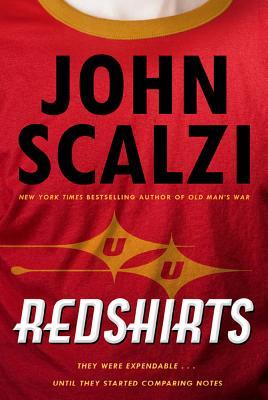
Books you should have read already: Redshirts

Sorry about the delay but, well you know, the hurricane and power outage and all that jazz. But I'm back and I have a fun pick this time.


This is flat out a satire and meta analysis of Star Trek. It takes the tropes and plays them out. But what this novel does is put realistic, logical, aware characters in the field of cliche and formula. And it's hilarious. You can take it as a love note to the franchise or you can take it as a playfully gruff punch on the shoulder to science fiction in general. There's a lot for Star Trek fans but there's more than enough for scifi fans as well.

And that's just the first part. Normally codas are little extras but with this book the three codas are equally as important as the story. They each continue the plot by way of different characters and it's really in these codas where the point of the book comes through. The amount of heartfelt love for the story, characters, and world is great. The story has touching moments but there's a lot of world building and deconstruction. The codas are these nuggets of pure character and each with its own perspective.

It's hard to review a book that's as meta as this. I don't want to come across as selling it as a Star Trek story because it absolutely is not. I don't want to sell it on the amazing irony and deconstruction because it stands on its own as a real science fiction story. It is what it is, and that's a funny, smart, highly entertaining book.